How to Establish a Firebreak on Rural Property
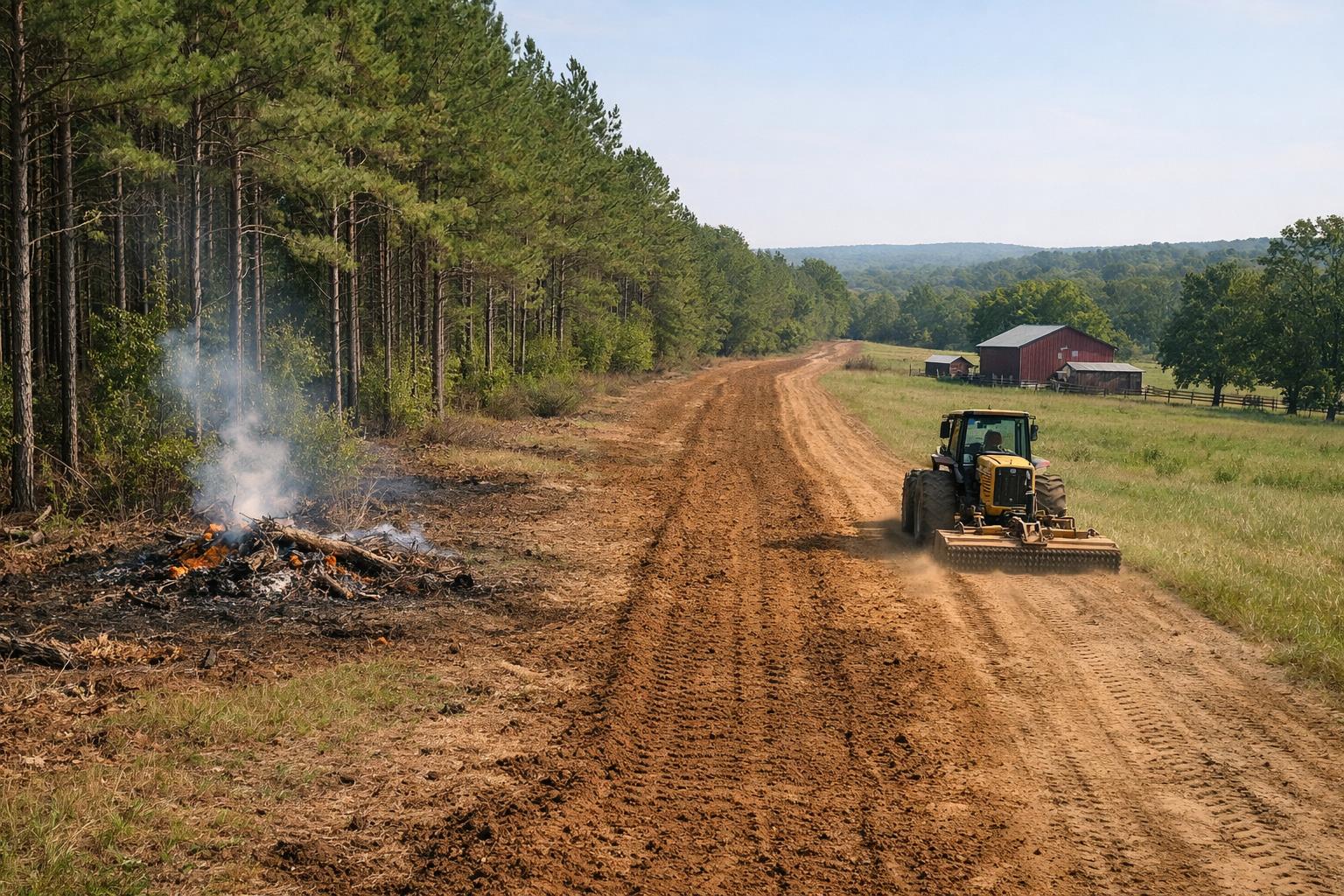
Firebreaks are strips of land where combustible vegetation has been removed or reduced to interrupt the path of a fire. On rural property they serve two distinct purposes: passive protection — stopping a wildfire from spreading across your land — and active use as containment lines when you're running prescribed burns to manage habitat, pasture, or timber.
A firebreak you build for wildfire protection is the same one you'll use when you light a backing fire along a field edge in February. Getting the network right once means you can burn safely for years without having to clear new lines every season.
This guide covers how to plan the layout, build the breaks, choose equipment, and maintain them so they hold up when it matters.
Planning the Layout
Before you cut a single strip, walk your property and sketch a rough map. You're looking for three things:
Natural boundaries. Roads, streams, field edges, and mowed areas are already partial firebreaks. A gravel road with a clean ditch on each side can stop most low-intensity surface fires. Your network should connect these natural barriers rather than duplicate them.
Property lines and structures. Prioritize firebreaks that create a buffer between the woods and your structures — barn, house, equipment shed. A firebreak 30 to 50 feet wide around the perimeter of a structure gives fire suppression crews room to work and time to respond. It also qualifies some properties for lower insurance rates.
Burn units. If you plan to prescribe burn any portion of your land, divide those areas into units you can light and control independently. Typical units run 20 to 100 acres depending on terrain. Each unit needs a firebreak on all four sides, with at least one side accessible to a water truck or tractor.
Sketch your break network so that no single line runs more than a quarter mile without connecting to another road, line, or natural barrier. Long isolated strips are hard to defend and require more personnel to hold during an active burn.
Choosing the Right Width
The width you need depends on what you're protecting against and how you'll use the break.
For general wildfire protection and prescribed burn containment in flat to gently rolling terrain, a cleared strip 10 to 15 feet wide is the working minimum. This is enough to stop a low-intensity surface fire burning through dry leaves or light grass with a moderate wind.
For areas with heavy fuel loads — dense brush, pine slash, tall dry grass — go 20 to 30 feet wide. High-intensity fires throw embers well ahead of the flame front; a wider break reduces the chance of spot fires jumping your line.
If you're managing a break that also serves as a road or equipment path, build it 15 to 20 feet wide so a tractor or side-by-side can travel the length without dragging brush.
When in doubt, go wider. A strip that's twice as wide as you think you need costs maybe 30 percent more to build and takes no more time to maintain, but it holds under conditions a narrow break would fail.
Construction Methods and Equipment
The approach that works best depends on vegetation type, terrain, and what equipment you have access to.
Tractor with bush hog or rotary cutter. This is the most common method for flat to moderately sloped ground with grass, briars, and light brush up to about 2 inches in diameter. Make two or three passes to cut the strip down to bare or low-mowed ground. Follow up with a disk or box blade to expose mineral soil on the center strip — a one-pass disked line down the middle of a mowed break dramatically improves its ability to stop a creeping surface fire.
Skid steer or compact track loader with mulching head. For heavier brush and young saplings, a mulching head shreds everything in its path and leaves the material ground into fine debris on the surface. This is faster than a bush hog in thick cover and leaves a cleaner result, but the mulch layer can still burn. Follow with a disk pass or scrape the center to mineral soil.
Dozer. For dense timber, logging slash, or terrain too rough for a tractor, a small dozer is the right tool. Push debris to the sides and leave the cleared strip exposed. Dozer-built breaks require more attention to water bars and erosion control on slopes, but they're the most robust option in heavy fuel areas.
Hand tools and chainsaw. On small properties or in areas inaccessible to equipment, cut and pile by hand. This is slow but targeted. Remove all shrubs, saplings, and brush from the break width; cut logs and pile them outside the break edge.
Regardless of method, finish every break with a disked or scraped mineral soil strip at least 3 feet wide down the center. Mineral soil is the most reliable fire stop in your break.
Grading and Water Management
Any firebreak that runs across a slope needs water management to prevent erosion. Without it, the first hard rain turns your carefully constructed break into a gully.
Water bars are the standard solution — angled berms or shallow ditches cut across the break at regular intervals to direct runoff off to the side rather than channeling it straight down the strip. Space them every 50 to 75 feet on slopes steeper than 5 percent, every 30 to 40 feet on slopes steeper than 10 percent.
A simple water bar is a small berm built by a disk or blade angled across the break, high side on the downslope end, with an outlet cut through the break edge so water flows into adjacent vegetation. Cut the outlet before rain, not after the gully starts.
On breaks that double as roads, crown the surface with a slight arch so water sheds to both sides rather than running down the center. Even a two-inch crown makes a significant difference in a heavy rain.
Annual Maintenance Schedule
A firebreak that isn't maintained stops being a firebreak. Vegetation fills in faster than most landowners expect — a clean strip in March can have knee-high regrowth by July and be nearly invisible by the following spring.
Early spring (February–March): Walk or drive every break before fire season and the growing season. This is when you identify what filled in over the last year. Mow or bush hog everything, re-disk the center strip, and cut any saplings that got a foothold.
Late summer (August–September): A second pass before fall fire weather. Mow any summer growth back. In fire-prone regions, this pass matters as much as the spring pass — dry fall grass grows right back through any summer regrowth you missed.
After every prescribed burn: Check the break perimeter for spots where fire crossed or nearly crossed. Note any sections where vegetation was too heavy and either widen those sections before the next burn or plan to pre-treat them with herbicide.
Adding a selective herbicide application — a broadcast spray of a grass-specific herbicide like clethodim, or a general vegetation suppressor on the mineral soil strip — can extend the interval between mechanical passes significantly. In high-regrowth areas, one herbicide application per season can replace one full mowing pass.
Integrating Firebreaks into Your Land Management Plan
Firebreaks do more than stop fires. Mowed and disked strips attract turkeys, quail, and deer that use the open ground for travel and foraging. They create early successional edge habitat along their margins. Combine your firebreak network with strategic hinge cutting in adjacent timber to build both open foraging strips and dense bedding cover side by side. They give you access routes into areas that are otherwise difficult to reach with equipment.
When you plan your network, think about how the breaks connect to food plots, stand locations, and water sources. A firebreak that runs from your main road to a back food plot gives you a quiet walking access route, a green strip after rain, and a containment line all in one. To get the most from these corridors, read Understanding Deer Bedding Areas on Small Acreage so you can route your breaks to avoid disturbing core rest sites while connecting to stand locations.
Build the firebreak network once with purpose and it pays back in safety, management flexibility, and habitat value for the life of your land. Landowners running livestock will find that firebreak corridors and paddock lanes work together naturally — Sustainable Farming Techniques for Small-Scale Growers covers how to integrate rotational grazing paths with the same infrastructure.
Stop Seeing Deer Only at 2 AM — Get the Free 10-Point Habitat Fix
Your property has specific, fixable gaps — and most 1–50 acre hunters never find them. This free checklist pinpoints exactly what's missing and tells you what to change first so deer start showing up when you can actually hunt them.
- ✓ The food plot timing that pulls deer into daylight hours
- ✓ How to build bedding cover with just a chainsaw (no equipment needed)
- ✓ Stand placement mistakes silently blowing out your property
- ✓ The #1 pressure rule most hunters skip — and deer remember
- ✓ Low-pressure access routes most small acreage owners never plan