How to Install a Low-Water Crossing on Rural Land
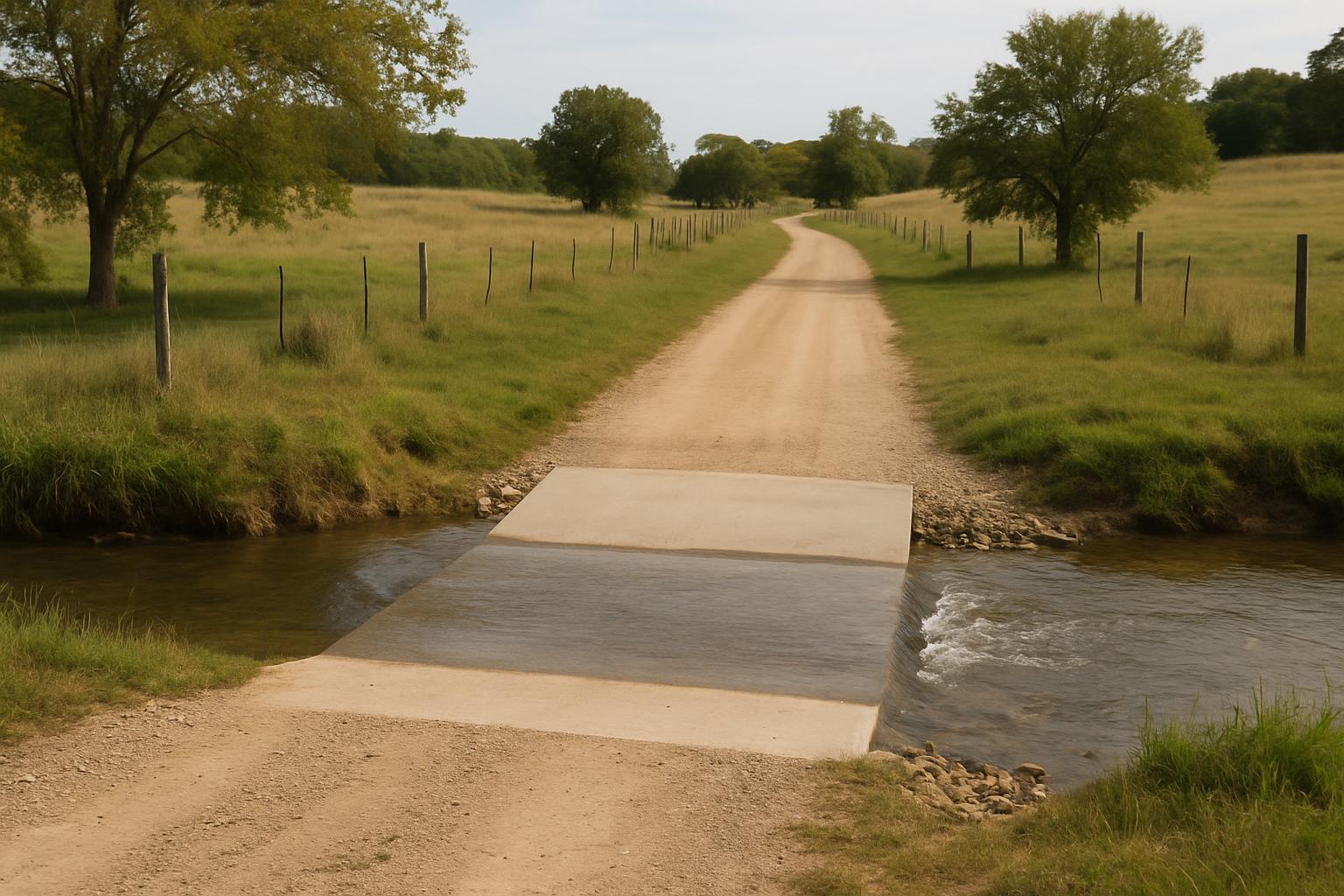
Why a Low-Water Crossing Beats a Makeshift Ford Every Time
A seasonal creek that cuts through your property can turn a 5-minute drive into a 45-minute detour every spring — or strand your tractor on the wrong side of the fence during hay season. Most small acreage landowners manage creek crossings with an informal ford: a gravel-covered low spot where vehicles splash through when the water is low enough. That works until the first flood scours out your gravel, undercuts the bank, and leaves you with a 2-foot drop into the creek where there used to be a gradual slope.
A properly built low-water crossing — one with compacted aggregate base, concrete or armored apron, and hardened banks — costs between $800 and $3,000 for a typical single-lane rural crossing and holds up for 20 to 30 years with minimal maintenance. This guide covers site selection, materials, construction sequence, and what permits you'll likely need before you start.
Step 1 — Choose the Right Crossing Location
Not every spot along a creek is a good candidate for a low-water crossing. The best location combines a narrow channel, stable banks, and a crossing angle that minimizes your road length in the water.
Look for the narrowest natural channel. Measure stream width at several potential crossing points during normal flow. A crossing that's 18 feet wide requires significantly less armoring material than one that's 30 feet wide. Aim for the narrowest point that still allows safe approach angles from both sides.
Check the banks for stability. Avoid locations where the bank is actively eroding, overhanging, or made of soft loam. Squeeze the bank soil in your hand — if it crumbles easily or has a loose sandy texture, it will continue to erode under traffic load and water scour. Crossing sites with clay-dominated banks, or banks reinforced by established tree root systems, are far more stable.
Plan for a crossing angle near 90 degrees. A crossing that approaches the stream at a right angle minimizes the length of road surface in the water and reduces the side-load forces on vehicles as they exit. A 45-degree crossing nearly doubles the in-stream road length and creates awkward approach geometry with a trailer.
Identify the flood frequency at that location. Talk to neighbors or check county flood maps. A crossing designed for normal flow will wash out in a 10-year flood if the design doesn't account for high-water events. For most small acreage crossings, designing for the 25-year storm event is a practical target.
Step 2 — Check Permit Requirements Before You Start
This is the step most landowners skip and later regret. Placing fill, gravel, or concrete in or near a stream channel is regulated in nearly every U.S. state. The specific agency and permit type vary, but common requirements include:
Nationwide Permit 14 (NWP 14) from the Army Corps of Engineers — covers road crossings of waters of the U.S. that affect less than 1/10 of an acre of wetland or stream. Most small rural low-water crossings qualify under NWP 14, which is a general permit with no application fee and minimal paperwork. Contact your local Army Corps district office to confirm your project qualifies.
State Section 401 Water Quality Certification — required alongside the federal NWP 14 in most states. Administered by your state environmental agency (varies by state). Typically requires a short project description and site sketch.
State stream alteration permit — some states require a separate permit for any in-stream construction. Check with your state's department of natural resources or environmental quality agency.
For many rural low-water crossings on small agricultural properties, the combined permit process takes 4 to 6 weeks and involves minimal cost. Start the process before you order materials — not after.
Step 3 — Prepare the Approach Roads and Bank Cuts
With permits in hand, start with the approach roads on both banks before touching the stream channel. Work from the high ground down.
Establish approach grades of 8 to 12 percent. A steeper approach creates traction problems when exiting the creek, especially for loaded trailers and in wet conditions. If the existing bank is steeper than 12 percent, cut it back and compact the new grade with a plate compactor or your tractor's bucket before installing base material.
Cut the bank back to stable soil. Remove any overhanging vegetation, root-undercut bank sections, or soft loam within 10 feet of the channel edge on both sides. The approach road needs to tie into the compacted base of the crossing on stable ground, not loose fill.
Install geotextile fabric on approach cuts. Before placing any gravel, lay a non-woven geotextile fabric across the cut bank surface. This separates the base aggregate from the native soil, prevents fine particles from migrating upward into your road surface, and dramatically extends the life of the aggregate. Use a fabric rated at 150 pounds per square inch puncture resistance or higher for heavy equipment crossings.
Step 4 — Build the In-Stream Base
The in-stream portion of a low-water crossing handles the most stress — vehicle loads, water flow, and seasonal freeze-thaw cycles all act on this section simultaneously.
Excavate to firm substrate. Remove soft stream bottom material (sand, silt, organic muck) down to firm gravel, rock, or hardpan clay. For most crossings this means excavating 18 to 24 inches below the existing stream bottom at the crossing point. Firm substrate is material that doesn't deflect under the bucket of your tractor.
Install a geotextile liner across the full excavated area. This prevents the base rock from gradually sinking into soft substrate and keeps fine material from migrating up through the aggregate over time.
Place 18 to 24 inches of compacted angular stone. Angular crushed stone — not rounded river rock — interlocks under compression and provides superior load-bearing capacity. Use AASHTO #57 or equivalent (1.5-inch angular crushed limestone or granite) as your base course. A 12-foot-wide by 20-foot-long crossing requires approximately 15 to 20 tons of base stone at this depth.
Top with 4 to 6 inches of AASHTO #8 (3/4-inch) compacted aggregate. This finer layer fills voids in the base and provides a more uniform driving surface. Compact each lift with a plate compactor before placing the next.
Consider a concrete apron for high-traffic crossings. If the crossing will see daily use by heavy vehicles (loaded grain trailers, manure spreaders), a 6-inch concrete apron poured over the compacted aggregate base dramatically extends service life. Use fiber-reinforced concrete with a minimum compressive strength of 4,000 psi, and score expansion joints every 8 feet. A concrete apron adds $400 to $800 to the project cost but can double or triple the maintenance interval.
Step 5 — Armor the Banks and Install Erosion Control
The transition zone between the in-stream structure and the approach road is where most low-water crossing failures begin. Water scours the bank edge during floods, undermining the compacted base from the sides.
Extend riprap armoring 10 to 15 feet up each bank. Use angular stone large enough to resist displacement in a moderate flood — D50 of 9 to 12 inches (meaning half the stones by weight are larger than 9 to 12 inches) is adequate for most rural crossings with flows under 100 cubic feet per second. Stack the riprap on the geotextile liner, not directly on native soil.
Seed and mulch disturbed bank areas immediately after construction. Use a fast-establishing erosion control seed mix appropriate to your region. Apply at double the normal seeding rate on disturbed bank slopes. Cover with erosion control matting (straw coconut fiber blanket) on slopes steeper than 3:1. Bare disturbed soil on a creek bank will lose 6 to 12 inches of material in the first good rain event.
Install silt fence 10 feet from the bank edge on both sides during construction if your permit requires it, and keep it in place until vegetation establishes to at least 70 percent ground cover.
Key Takeaways
- Select the narrowest, most stable crossing point at a near-90-degree approach angle to minimize material requirements and traffic difficulty.
- Obtain Army Corps NWP 14 and any state stream permits before starting — the process typically takes 4 to 6 weeks for small rural crossings.
- Excavate to firm substrate (18 to 24 inches minimum) and use geotextile liner before placing aggregate to prevent base migration.
- Use angular crushed stone, not river rock — angular aggregate interlocks under load and handles vehicle traffic dramatically better.
- Armor banks with riprap extending 10 to 15 feet from the channel edge and seed disturbed areas immediately to prevent scour failure.
- Budget $800 to $3,000 for a single-lane agricultural crossing; add $400 to $800 for a concrete apron if the crossing sees daily heavy-equipment use.
Stop Seeing Deer Only at 2 AM — Get the Free 10-Point Habitat Fix
Your property has specific, fixable gaps — and most 1–50 acre hunters never find them. This free checklist pinpoints exactly what's missing and tells you what to change first so deer start showing up when you can actually hunt them.
- ✓ The food plot timing that pulls deer into daylight hours
- ✓ How to build bedding cover with just a chainsaw (no equipment needed)
- ✓ Stand placement mistakes silently blowing out your property
- ✓ The #1 pressure rule most hunters skip — and deer remember
- ✓ Low-pressure access routes most small acreage owners never plan