Rotational Grazing Schedules for 5- to 15-Acre Properties
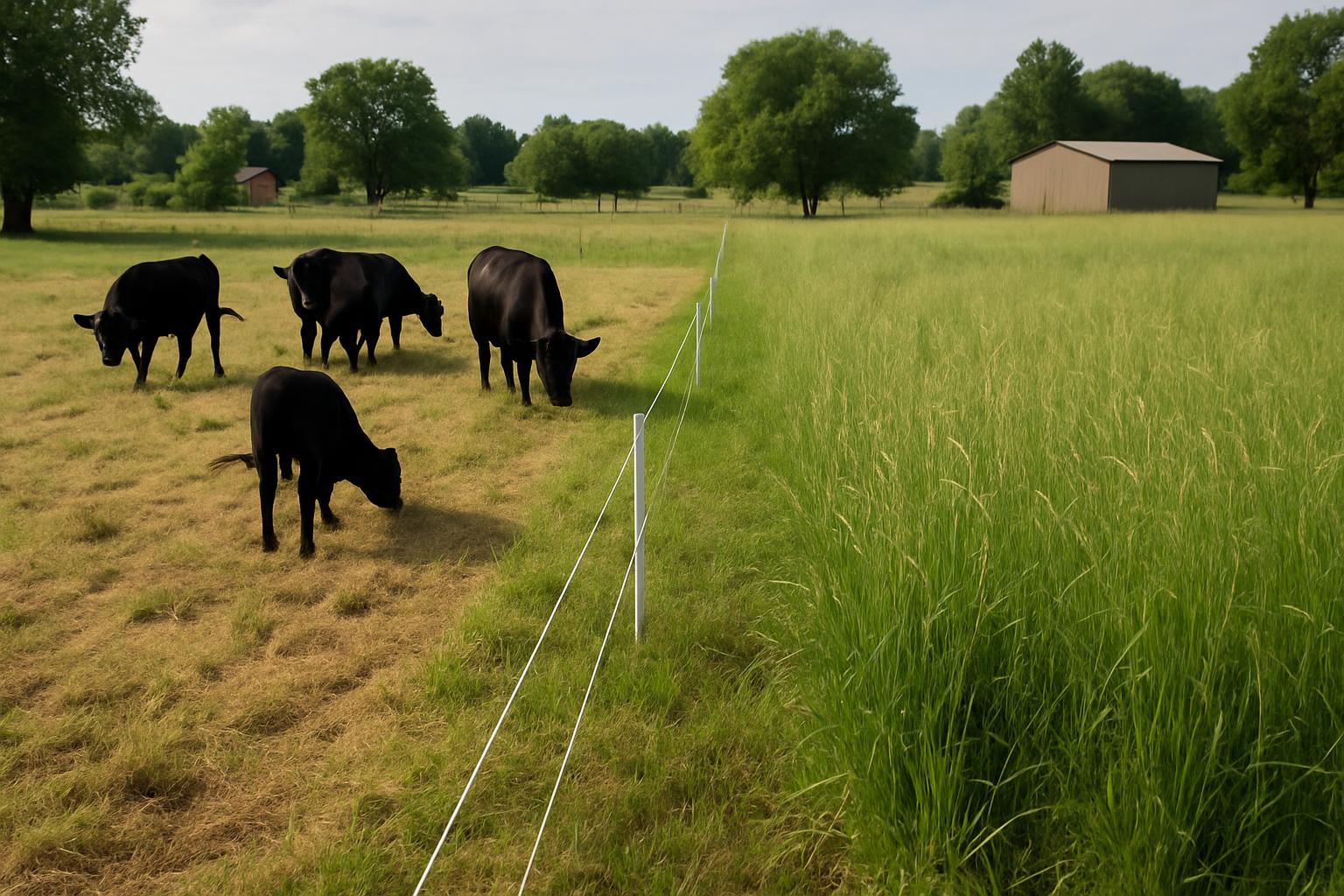
Why Rotational Grazing Works on Small Acreage
If you've been running cattle, goats, or sheep on the same 5 to 15 acres continuously, you've probably noticed the pattern: the grass near the water tank and shade tree gets hammered down to dirt while the far corners grow rank and unpalatable. Continuous grazing on small acreage causes this every time. Animals revisit their favorite spots before those areas can recover, and the weakest plants get grazed out first.
Rotational grazing breaks that cycle. By dividing your pasture into smaller paddocks and moving livestock before they overgraze any one area, you give plants time to regrow from the roots. The difference after one season is often dramatic — thicker stands, less bare ground, fewer weeds, and animals that actually gain weight instead of struggling to find enough to eat.
On 5 to 15 acres, a simple three- to four-paddock rotation is enough to see measurable improvement. You don't need expensive infrastructure or complex software. You need a fence plan, a calendar, and the discipline to move animals on schedule.
Step 1: Assess What You're Working With
Before dividing the pasture, walk every section and take stock of what's growing, what condition it's in, and where the wet and dry spots are.
Grass condition rating. For each section, estimate the average grass height and density. Healthy cool-season grasses (fescue, orchard grass, bluegrass) should be grazed when they reach 6 to 8 inches and removed from the paddock when they're grazed down to 3 to 4 inches. Warm-season grasses (bermudagrass, bahiagrass) tolerate shorter grazing — enter at 8 to 10 inches, exit at 4 inches.
Problem areas. Note wet areas that stay muddy, brushy corners that livestock won't graze, and compacted sacrifice areas near water or gates. These need separate management — they don't benefit from being included in the rotation as equal paddocks.
Carrying capacity estimate. A rough starting rule for small acreage: one cow-calf pair per 1.5 to 2 acres of good pasture per grazing season, or one to two goats per acre. These numbers assume adequate rainfall and fertilization. If your pasture is in poor condition, assume half of that until you see improvement.
Step 2: Divide Your Pasture Into Paddocks
For 5 to 15 acres, a three- to four-paddock system is the practical sweet spot. Fewer than three paddocks doesn't give enough rest time. More than four on 15 acres or less creates paddocks that are too small to manage efficiently without significant fencing investment.
Paddock sizing. Divide roughly equally by acreage, adjusted for pasture quality. If one section has heavy brush or a wet low spot, make it slightly larger so the effective grazing area is comparable to the other paddocks.
Fencing options. Permanent perimeter fencing is already in place on most properties. The interior divisions can be:
- Permanent woven wire or high-tensile — the most durable option, appropriate if you're committed to the layout long-term
- Single-strand electric polytape — easy to move if you want to adjust paddock sizes seasonally, works well for cattle and horses that respect electric
- Step-in post and two-strand electric — the lowest-cost temporary option, allows complete flexibility but requires daily attention to keep animals from pushing through
For most small acreage operations, semi-permanent single-strand electric with fiberglass or step-in posts is the right balance of cost and flexibility.
Water access. Every paddock needs water. If your water tank is in one location, either run a line to each paddock or use a portable tank you move with the animals. Livestock won't use a paddock properly if the walk to water is inconvenient. On 5 acres, a centrally located tank accessible from two or three paddocks through a shared gate lane works well.
Step 3: Set Your Rest Period
Rest period is the most critical number in a rotational grazing system. This is how long the paddock rests — no livestock — before the next grazing cycle. Get this right and your pastures improve. Get it wrong and you're just moving your overgrazing problem around.
Cool-season grasses (fescue, orchardgrass, bluegrass, ryegrass): 25 to 35 days rest in spring and fall when growth is fast; 45 to 60 days rest in summer when growth slows.
Warm-season grasses (bermudagrass, bahiagrass, native bluestem mixes): 21 to 28 days rest during the growing season (May through September); no grazing needed in true dormancy.
Mixed stands, which is what most small acreage properties have: use the conservative number — 35 days rest as your default and adjust based on whether the grass is recovered to the target height when you return.
With a four-paddock system and a 35-day rest target, each paddock gets grazed for roughly 8 to 12 days before rotating. Adjust the grazing period based on how fast the animals graze it down to your exit height (3–4 inches for cool-season grasses), not by the calendar alone.
Step 4: Build Your Rotation Calendar
Once you know your paddock count and target rest period, lay out a simple calendar.
A sample schedule for a four-paddock system with a 35-day rest period on 10 acres with 4 cow-calf pairs:
| Week | Paddock Grazed |
|------|----------------|
| Week 1–1.5 | Paddock A |
| Week 1.5–3 | Paddock B |
| Week 3–4.5 | Paddock C |
| Week 4.5–6 | Paddock D |
| Week 6–7.5 | Return to Paddock A (now ~35 days rest) |
In fast spring growth, the grass recovers faster and you may complete the rotation in 28 days. In summer heat, recovery slows and you may need to extend the cycle to 45 days or supplement with hay.
Rule of thumb: move based on grass height, not just the calendar. The calendar is a starting point. The pasture tells you when to move.
Step 5: Manage the Transition Period
The first season of rotational grazing requires extra attention because your pastures are likely starting in poor condition.
Expect a rough first 60 days. Weak grass plants that were continuously grazed may not recover well in the first cycle. Weeds that moved into overgrazed areas compete for space. This is normal. Keep rotating — the second and third cycles show dramatic improvement as healthy grass plants outcompete the weeds.
Sacrifice one paddock if needed. If conditions turn dry or you're waiting for grass to recover across the entire rotation, keep animals in one paddock and let the rest recover. A sacrifice paddock takes more damage but saves the other paddocks. Rotate back in as soon as recovery allows.
Feed hay to extend rest periods. In dry periods or when grass is slow to recover, supplementing with hay in the current paddock lets you hold animals in place without grazing the other paddocks into the ground. This is cheaper than the pasture damage caused by forcing a premature rotation.
Step 6: Evaluate and Adjust After the First Season
At the end of the first full rotation season, walk each paddock and compare notes to what you saw at the start.
Look for these improvements:
- Increased grass density in areas that were bare or thin at the start
- Fewer weeds in previously overgrazed patches
- More even grazing across the paddock rather than concentrated areas
- Faster recovery between cycles than the first rotation
If recovery is still slow, extend rest periods by 7 to 10 days in the next season. If animals are finishing a paddock too fast before you're ready to move, either increase the stocking density slightly or adjust paddock sizing.
The numbers in this guide are starting points. Every property has different soils, rainfall, grass species mixes, and stocking rates. Track what's actually happening — rest period, grazing height at entry and exit, days to recover — and your rotation will get more dialed in with each passing season.
Key Takeaways
- Divide your 5 to 15 acres into three to four roughly equal paddocks using permanent or semi-permanent electric fencing
- Target a 25 to 45 day rest period per paddock depending on grass species, season, and growth rate
- Move livestock based on grass height at exit (3–4 inches for cool-season grasses), not just the calendar
- Every paddock needs accessible water — centrally located tanks with shared gate lanes work on small acreage
- Expect visible improvement in grass density and weed pressure after two to three complete rotation cycles
- In drought or slow recovery periods, use hay to hold animals in place rather than forcing a premature move that damages recovering paddocks
Stop Seeing Deer Only at 2 AM — Get the Free 10-Point Habitat Fix
Your property has specific, fixable gaps — and most 1–50 acre hunters never find them. This free checklist pinpoints exactly what's missing and tells you what to change first so deer start showing up when you can actually hunt them.
- ✓ The food plot timing that pulls deer into daylight hours
- ✓ How to build bedding cover with just a chainsaw (no equipment needed)
- ✓ Stand placement mistakes silently blowing out your property
- ✓ The #1 pressure rule most hunters skip — and deer remember
- ✓ Low-pressure access routes most small acreage owners never plan