Sustainable Farming Techniques for Small-Scale Growers
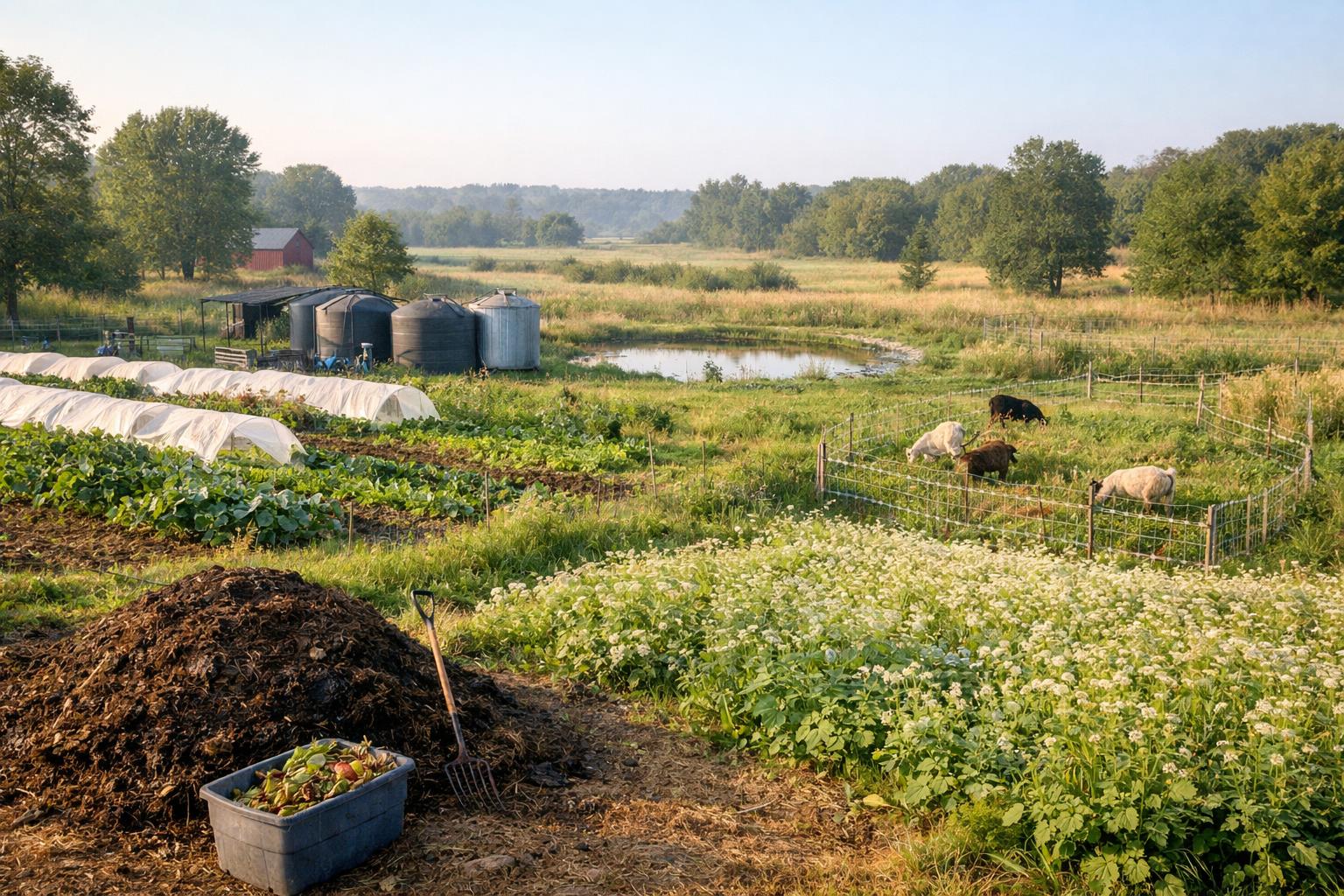
Why Sustainability Matters More on Small Farms
Large-scale commodity farms can absorb input costs, soil degradation, and yield variability in ways that small growers simply cannot. On a five-acre market garden or a twenty-acre diversified farm, every mistake shows up fast — in depleted beds, weed pressure that overwhelms a two-person crew, or a dry August that kills a cash crop because there's no irrigation backup.
Sustainable techniques aren't idealism on a small farm. They're risk management. Building organic matter, cycling nutrients on-site, and retaining water in the soil all reduce your exposure to the things that end small farming operations: input cost spikes, drought, and exhausted ground that stops producing.
This guide covers the core practices that experienced small-scale growers rely on to keep their land producing year after year without burning through money or burning out the soil.
Cover Cropping: The Foundation of Soil Health
A cover crop is any crop grown primarily to benefit the soil rather than to harvest for sale or feed. Small farms use them in the off-season, between cash crops, and as living mulches under taller plants.
What cover crops do:
Cover crops protect bare soil from rain compaction and erosion. They add organic matter when terminated and tilled in. Legume covers — crimson clover, hairy vetch, field peas — fix atmospheric nitrogen and release it as they break down, cutting fertilizer costs. Deep-rooted covers like tillage radish and turnips break up compaction layers without mechanical tillage.
Choosing the right mix:
Single-species covers work, but mixes outperform them on most small farms. A simple cereal rye plus hairy vetch mix gives you biomass (rye) plus nitrogen fixation (vetch) in one planting. For summer covers, sorghum-sudangrass suppresses weeds aggressively and builds large amounts of organic matter.
Match your cover crop timing to your cash crop rotation. Winter covers seeded in late September through October work well in most of the country. Summer covers fill gaps between spring and fall plantings.
Termination timing matters:
Terminate covers before they set seed and at the right moisture level for your tillage approach. Rolling and crimping — flattening the cover with a roller crimper — kills it without tillage and leaves a weed-suppressing mulch mat. This technique suits no-till and reduced-till operations well.
Composting: Closing the Nutrient Loop
Buying fertility is expensive and creates dependency. Small farms that compost their own waste — vegetable scraps, spent crop residue, manure from on-farm animals, cardboard and straw bedding — reduce input costs and improve soil biology at the same time.
Hot composting basics:
A hot compost pile needs four things: carbon materials (straw, wood chips, cardboard), nitrogen materials (manure, fresh plant waste, food scraps), moisture (like a wrung-out sponge), and oxygen. The ratio of carbon to nitrogen by weight should run roughly 25–30 to 1.
Build the pile in layers, mixing browns and greens as you go. A pile that reaches 130–160°F in the core will kill most weed seeds and pathogens. Turn it every few days when it's active. In 30–60 days under active management, raw materials become stable, crumbly compost.
Scale for your operation:
A two-bin or three-bin system works well for most small farms — one bin active, one curing, one finished and ready to use. For farms with livestock, a dedicated manure composting pad away from waterways keeps nutrients on the farm instead of running off in rain events.
Apply finished compost at 1–3 inches per bed per season. You'll see improved soil structure, better water retention, and fewer fertilizer needs within two or three seasons.
Rotational Grazing for Livestock Keepers
If your small farm includes cattle, sheep, goats, or pigs, how you graze makes more difference to your pasture than almost any other management decision. Continuous grazing — turning animals into a large area and leaving them — degrades pastures steadily. Rotational grazing — moving animals through smaller paddocks on a schedule — builds them.
The core principle:
Graze a paddock hard for a short period, then rest it long enough for full recovery before grazing again. Recovery periods depend on your climate and season. In active growing season, 21–30 days may be enough. In late summer or drought, extend rest periods to 60–90 days.
Setting up a simple rotation:
Divide your available pasture into four to six paddocks using temporary electric fencing. Polywire and step-in posts let you reconfigure paddocks cheaply as your herd size or forage conditions change. Move animals when the grass in the current paddock drops to about 3–4 inches, before they start grazing root reserves.
What you'll see over time:
Rotational grazing increases forage diversity, reduces bare ground, improves water infiltration, and increases organic matter from trampled plant material and manure. Most small-scale graziers see meaningful pasture improvement within one to two grazing seasons. The mowed paddock lanes and perimeter paths you build for rotational grazing also form the foundation of a firebreak network — How to Establish a Firebreak on Rural Property shows how to design these strips to serve both functions from the start.
Water Harvesting and Retention
Water is the limiting resource on most small farms. How you capture and hold it matters as much as how much rain falls.
Swales and earthworks:
A swale is a level trench or berm dug on contour — following lines of equal elevation — to slow runoff and let it soak in rather than sheet off the land. On a hillside, a series of swales can dramatically increase the effective rainfall your land captures. Fruit trees and perennial crops planted on the downhill berm of each swale benefit from the stored moisture all season.
Earthworks are a one-time investment with decades of payback. A small dozer or track loader can cut swales on a few acres in a day. Plan from a topographic map or use a hand level to mark contour lines before any digging.
Mulching to hold what you have:
Three to four inches of wood chip mulch on permanent beds slashes evaporative water loss, moderates soil temperature, and suppresses weeds. Chipped wood from tree service companies is often free or low-cost. Apply it generously around trees, perennial plantings, and between annual crop beds.
Catchment and simple storage:
A 1,500-gallon cistern fed from a barn or shed roof provides meaningful irrigation backup for a kitchen garden or nursery. For larger scale, a small pond sited at a catchment low point stores water for gravity-fed drip irrigation during dry stretches. Even modest storage buffers against the brief dry spells that damage crops at critical growth stages. The same pond can serve double duty as wildlife habitat — How to Build a Small Wildlife Pond on Rural Property covers sizing, spillway design, and long-term management for dual-use water features.
Integrated Pest Management Without Heavy Chemical Use
Pest and disease pressure doesn't disappear on sustainable farms — it just shifts toward a balance point where beneficial insects, healthy soil, and diverse plantings keep problems manageable without calendar spray programs.
Start with resistant varieties:
Seed selection is your cheapest pest and disease management tool. Choose varieties with documented resistance to the most damaging pressures in your region. For tomatoes, that means varieties with resistance to early blight, late blight, or fusarium depending on your location. For cucumbers, powdery mildew tolerance. For small grains, varieties with good lodging resistance and disease packages.
Diversify plantings:
Monocultures concentrate pests. Mixed plantings, crop rotation, and intercropping with flowering plants that support beneficial insects all reduce pest pressure. A border of buckwheat, phacelia, or sweet alyssum around vegetable beds provides nectar and habitat for predatory wasps, lacewings, and ground beetles that eat pest insects.
Scouting before spraying:
Walk your crops twice a week during peak season. Identify what you're seeing before you reach for any input, organic or conventional. Most pest populations go through boom and bust cycles, and spraying at the wrong time can kill the beneficials that would have handled the problem naturally. Knowing your pest threshold — how much damage is acceptable before economic harm occurs — saves money and avoids unnecessary inputs.
Crop Rotation as Disease Prevention
Rotating crop families through different fields or beds year over year is the single most effective disease prevention strategy available to small farmers. Soil-borne pathogens — fusarium, verticillium, sclerotinia, clubroot — build up when the same host crops grow in the same ground repeatedly.
A simple four-year rotation framework:
- Heavy feeders (corn, tomatoes, squash, brassicas)
- Legumes and cover crops (beans, peas, clover)
- Root crops and alliums (carrots, beets, onions, garlic)
- Cover crop rest (rye, vetch, oats)
Even a simple two-year rotation — nightshades one year, everything else the next — breaks the reproduction cycle of many common soilborne diseases.
Keeping records:
You can't rotate without knowing where things grew. A simple hand-drawn field map updated each season costs nothing. A spreadsheet with bed numbers and crops by year gives you a rotation schedule you can follow without guessing. Small farms that skip this step end up replanting in the same spots by accident and wonder why disease pressure keeps returning.
Building Toward Long-Term Productivity
Sustainable farming on a small scale isn't a fixed set of practices — it's a direction. The goal is land that becomes more productive, more resilient, and less expensive to farm over time as organic matter builds, biology matures, and the farmer's local knowledge deepens.
The practices here — cover cropping, composting, rotational grazing, water harvesting, integrated pest management, and crop rotation — work together. If your farm borders woodlots or brushy land, pairing these techniques with intentional wildlife habitat work — starting with understanding deer bedding areas on your acreage — adds hunting and wildlife value to land that might otherwise sit unused. Each one makes the others more effective. A farm that does all of them consistently for five years looks and performs dramatically differently than one that relies on purchased inputs and continuous cultivation.
Start with one or two practices that fit your current operation. Add others as you gain confidence and resources. The compounding effect of these techniques is real, and it rewards patience.
Key Takeaways
- Cover crops protect soil between cash crop cycles, suppress weeds, and fix nitrogen without purchased inputs.
- Composting closes the nutrient loop on your farm, turning waste into fertility and reducing dependency on off-farm fertilizers.
- Rotational grazing improves pasture density and soil health while reducing parasite load — without chemical intervention.
- Water harvesting (swales, ponds, rain gardens) extends soil moisture through dry periods and reduces runoff erosion.
- Integrated pest management targets pests with the least disruptive tools first, preserving beneficial insect populations that do the work for free.
- Crop rotation breaks disease and pest cycles naturally, often eliminating the need for fungicide applications.
- Start with one or two practices that fit your operation today, then layer in others as your confidence and resources grow.
Stop Seeing Deer Only at 2 AM — Get the Free 10-Point Habitat Fix
Your property has specific, fixable gaps — and most 1–50 acre hunters never find them. This free checklist pinpoints exactly what's missing and tells you what to change first so deer start showing up when you can actually hunt them.
- ✓ The food plot timing that pulls deer into daylight hours
- ✓ How to build bedding cover with just a chainsaw (no equipment needed)
- ✓ Stand placement mistakes silently blowing out your property
- ✓ The #1 pressure rule most hunters skip — and deer remember
- ✓ Low-pressure access routes most small acreage owners never plan