Hinge Cutting for Deer Habitat on Small Acreage
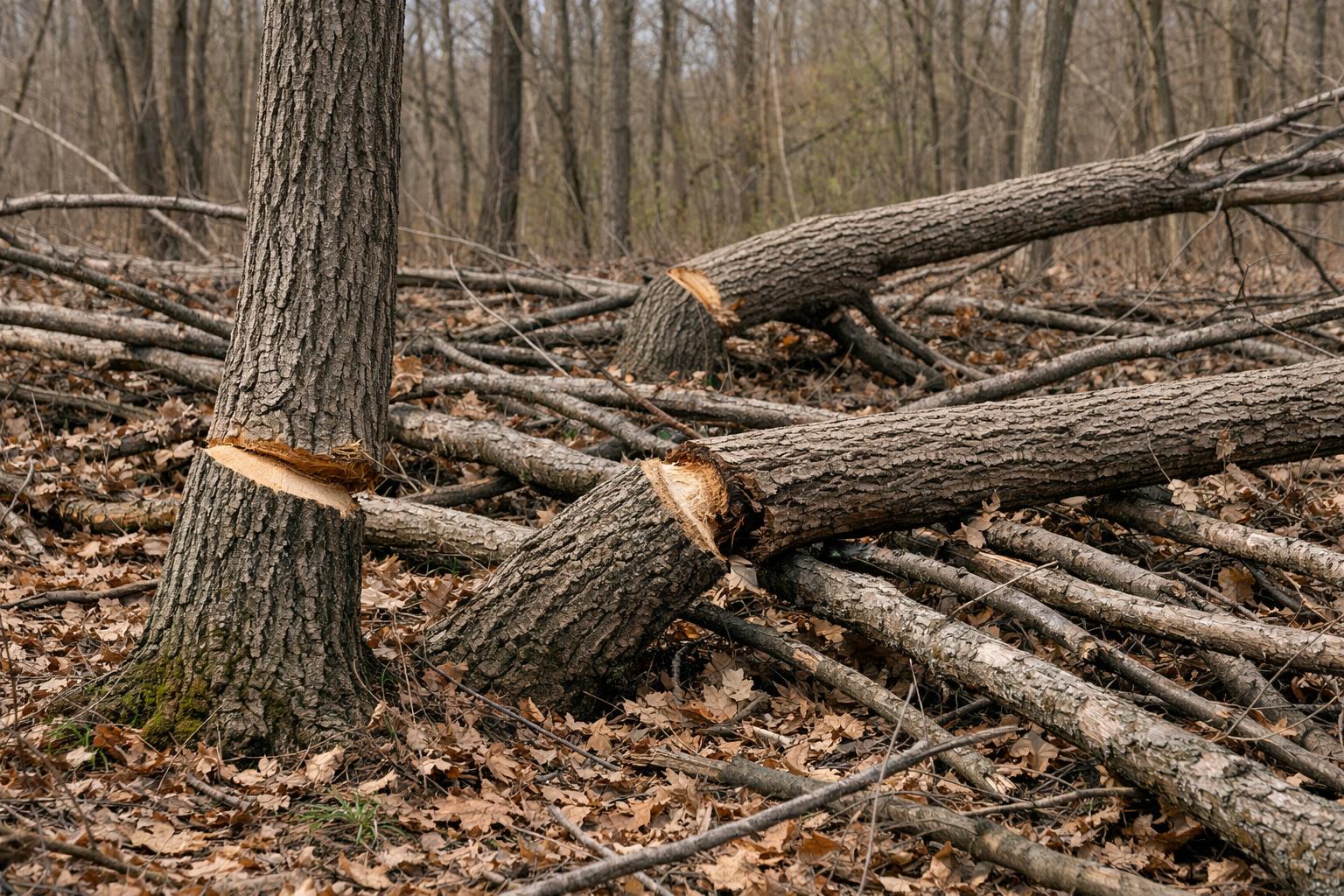
Hinge cutting is exactly what the name describes: you cut a tree partway through at knee to waist height, then push the top over so it falls and lays horizontally while remaining attached to the stump. The tree doesn't die immediately. The root system keeps pumping water and nutrients into the fallen crown, and the leaves stay green and edible for one to three growing seasons. Meanwhile, the downed top creates instant horizontal cover — a dense tangle of branches, leaves, and bark at deer height that small parcels almost never have enough of naturally.
For landowners managing five to fifty acres for whitetail deer, hinge cutting delivers more habitat improvement per dollar spent than almost any other single practice. No equipment rental, no seed cost, no waiting years for plantings to establish. You walk in with a chainsaw and walk out having created bedding cover, browse, and travel structure in the same afternoon.
Why Hinge Cuts Work for Deer
Deer need layered cover. A mature forest with a closed canopy and bare ground underneath looks like good habitat on a map but offers deer almost nothing. There's nowhere to bed with concealment, nothing to browse, and no visual screen that lets a deer feel secure at midday.
Hinge cutting breaks the canopy in specific spots and pushes biomass down to the level where deer live — from the ground up to about ten feet. The fallen crown creates:
Bedding cover. The tangle of branches at the base of a hinge cut creates a natural blind. Deer bed inside or tight against the fallen top, using the structure for concealment and wind advantage. A cluster of several hinge cuts in a quarter-acre patch becomes a dedicated bedding area within weeks of cutting.
Browse. Deer eat the leaves and small-diameter twigs of most hardwood species. A fresh hinge cut puts several hundred pounds of browse within reach. Species like red and white oak, aspen, maple, and birch are particularly palatable. Deer will return to graze on fallen tops through the first and second growing season.
Soft mast from root sprout growth. When you cut or hinge a tree, the root system responds by sending up new shoots from the base. These epicormic sprouts grow fast — sometimes three to five feet in a single season — and create a multi-stem clump of young growth that provides both cover and browse for years. This regenerative response is one reason hinge cutting keeps improving a site after the initial work is done.
Visual screening for travel. Deer moving through open woods are exposed. A row of hinge cuts along a ridge edge or a creek bottom creates a vertical screen that lets deer move through the area with their guard down. This concentrates deer movement along predictable corridors that you can hunt around.
When to Hinge Cut
Timing matters. The goal is to keep the hinge tree alive as long as possible so it continues producing leaves, browse, and soft cover.
Late winter is the best time — February through early March in most of the whitetail range. The tree is fully dormant, sap hasn't risen yet, and the root system is fully charged with stored energy. A dormant-season hinge cut survives and leafs out the following spring, giving you a full growing season of green browse starting almost immediately after deer season closes.
Cuts made in late spring after leaf-out or in summer tend to stress the tree more heavily because stored energy is already depleted. The tree often browns out faster and may die by the end of its first growing season rather than persisting for two or three years.
Avoid cutting during hunting season if the area you're working is near active stand sites. The noise, scent, and disturbance of chainsaw work will blow out deer from the surrounding area for days. Plan hinge cutting as an off-season project — late winter or very early spring is ideal because deer have already shifted their core areas for the season and the disturbance window closes before summer establishes new patterns.
What Species to Hinge Cut
Not every tree in your woodlot is a good candidate. Hinge cutting works best on mid-sized hardwoods — generally four to ten inches in diameter at the cut height. Larger trees are difficult to control when they fall, and smaller trees don't produce enough cover mass to justify the cut.
High-value hinge cut species:
Aspen and cottonwood are among the best. Both species send up aggressive root sprout regeneration, and deer find aspen bark, twigs, and leaves highly palatable. Hinge cutting aspen can trigger a flush of root sprouts so dense it becomes nearly impenetrable ground cover within two growing seasons.
Red and white oak produce palatable browse in the hinge top and the root system may sprout new growth, though oaks are slower to regenerate than aspen. Any tree currently producing acorns should usually be left standing — you want the mast production more than the cover. Target suppressed oaks that have poor canopy and aren't producing well.
Maple, birch, and beech all work well. Deer browse the tops readily and the root systems respond with sprout growth. Red maple in particular is aggressive in sending up new shoots after cutting.
Ironwood and hornbeam are often overlooked. These understory trees are thick-branched and create particularly dense horizontal structure when hinge cut. Deer bed tight against ironwood tops more consistently than almost any other species in the northern hardwood range.
Species to avoid or treat with caution:
Conifers — pines, spruces, firs — do not respond well to hinge cutting. The top will die quickly, and conifers don't produce root sprout regeneration. If you need conifer cover for thermal protection, plant it rather than trying to hinge existing trees.
Black cherry and black walnut contain compounds that can be mildly toxic to deer in large quantities and are generally skipped in favor of more palatable species. Neither is a priority hinge cut target.
Selecting Cut Height and Angle
Cut height determines how long the tree survives and how the fallen top lays. The sweet spot for most hardwoods is knee height to hip height — roughly 18 to 36 inches above ground. This keeps the root-to-crown connection short enough that the root system can maintain the fallen top efficiently, and it puts the densest part of the crown close to the ground where deer will actually use it.
Cut at a slight downhill angle on slopes — this lets water drain away from the exposed cut face rather than pooling and accelerating rot. On flat ground, a slight angle in any direction is fine.
The cut itself should go through 60 to 75 percent of the trunk diameter. Too shallow and the tree springs back upright or the hinge breaks unpredictably when you push it. Too deep and the hinge snaps completely, killing the connection to the root system immediately. A good hinge lets you feel the tree lean and stay when you push — the remaining wood flexes under the weight without breaking.
Push the tree in the direction you want it to fall before making your final cut. On small-diameter trees you can often push by hand as you finish the cut. On larger stems, a cant hook or a rope gives you control over the fall direction. Lay hinge cuts so the tops fall toward the interior of your target bedding area, not across it in ways that block deer movement.
Laying Out a Hinge Cut Block
A single hinge cut does very little. A well-designed cluster of cuts creates a functional bedding area and travel structure that deer will use for years. Think in terms of patches rather than individual trees.
Target a quarter acre to half an acre minimum for a dedicated bedding area. Smaller patches get visited but not used for regular bedding — deer need enough cover that they feel secure from multiple approach angles, not just one.
Leave vertical trees throughout the block. The goal is not to clear-cut a stand. Leave one to two mature trees per quarter acre standing to provide overhead structure and shade. This also maintains a forest floor environment rather than opening the area up to invasive species pressure that a full clearcut invites.
Cut a perimeter, then fill in. Start by hinge cutting the trees on the outside edge of your target block toward the interior. This creates an outer wall of horizontal cover. Then cut interior trees outward from the center or in alternating directions to create a layered, complex structure. Avoid laying all tops in the same direction — mixed fall directions create more varied structure that deer use differently.
Build in one or two entry trails. Deer need to be able to get into and out of the bedding area without fighting through the entire cut. Leave a few corridors — maybe four to six feet wide — that allow access. These also become your stand site approaches if the corridors are positioned correctly relative to your hunting access routes. These same cleared corridors are natural candidates for firebreak lines — see How to Establish a Firebreak on Rural Property for how to build and maintain them as part of the same land management plan.
Connect to food and water. A bedding block isolated from food sources will see less consistent use than one with a clear travel corridor to a food plot, oak flat, or agricultural field within 200 to 400 yards. When choosing where to cut, look for positions on your property that let deer move from the hinge cut area to food under cover or along a screened edge. Pairing your hinge cut layout with a clear picture of how deer select and use bedding areas makes the placement decisions significantly easier.
Safety Considerations
Hinge cutting with a chainsaw involves real hazards that are different from standard felling.
The tree does not fall away from you in a predictable arc — it falls and stays connected, and the top can swing, bounce, or kick unpredictably as the hinge bends. Never position yourself behind a hinge cut tree as you push it. Stand to the side, or use a rope or cant hook to push from a safe distance.
On steep slopes, hinge cut trees can roll downhill as they fall, especially on wet ground. Work from above the target tree when possible, and never let the falling top swing back toward you on a slope.
Wear a helmet with face shield, chainsaw chaps, steel-toed boots, and hearing protection. Hinge cutting moves fast — you can cut twenty to thirty trees in a half-day session — which means fatigue accumulates and attention drifts. Take breaks, keep your footing clear, and stop before you're too tired to work safely.
What to Expect in Year One and Year Two
The first season after cutting, deer will find the new cover quickly — often within days if they're already using the surrounding area. Expect to see trail camera activity in and around the hinge cuts within a week or two of completion. Early April through May, when the downed tops are still leafing out with fresh green growth, you'll see heavy browsing pressure.
By late summer of the first year, the downed tops are fully leaved out and the cover is at peak density. Root sprout growth from cut stumps starts to appear. This is when deer begin bedding regularly in the block rather than just visiting to browse.
In year two, the fallen tops start losing some density as branches die back, but root sprouts from the stumps are gaining height and filling in. By the end of year two, a well-cut block has a mix of structure: older horizontal framework from the fallen tops and fresh vertical regrowth from stumps. This combination is more complex and useful than either alone.
By year three to five, some of the fallen tops have decomposed enough to lose structure, but the stump sprouts are now two to five feet tall and creating their own cover layer. The site continues to improve if you did initial cuts correctly and left standing vertical trees to shade the understory and prevent invasive species from overwhelming the regenerating native growth.
Summary
Hinge cutting is the most accessible and immediate habitat improvement available to small acreage landowners. The technique is straightforward: cut four to ten inch hardwoods at knee to hip height through 60 to 75 percent of the diameter, push the top over, and let the root system keep it alive for two to three growing seasons. Work in late winter before sap rise, focus on palatable hardwoods like aspen, maple, birch, and ironwood, and build in quarter-acre to half-acre blocks rather than isolated individual cuts. Done correctly, a half-day of chainsaw work creates bedding cover, browse, and travel structure that holds deer on your property year-round and organizes every other habitat and hunting decision around a known, reliable anchor point. Pair hinge cutting with the other cover types detailed in Creating Bedding Areas That Hold Deer on Your Property Year-Round — native grasses, topography selection, and low-disturbance access — to build a complete system.
Stop Seeing Deer Only at 2 AM — Get the Free 10-Point Habitat Fix
Your property has specific, fixable gaps — and most 1–50 acre hunters never find them. This free checklist pinpoints exactly what's missing and tells you what to change first so deer start showing up when you can actually hunt them.
- ✓ The food plot timing that pulls deer into daylight hours
- ✓ How to build bedding cover with just a chainsaw (no equipment needed)
- ✓ Stand placement mistakes silently blowing out your property
- ✓ The #1 pressure rule most hunters skip — and deer remember
- ✓ Low-pressure access routes most small acreage owners never plan