How to Build a Small Wildlife Pond on Rural Property
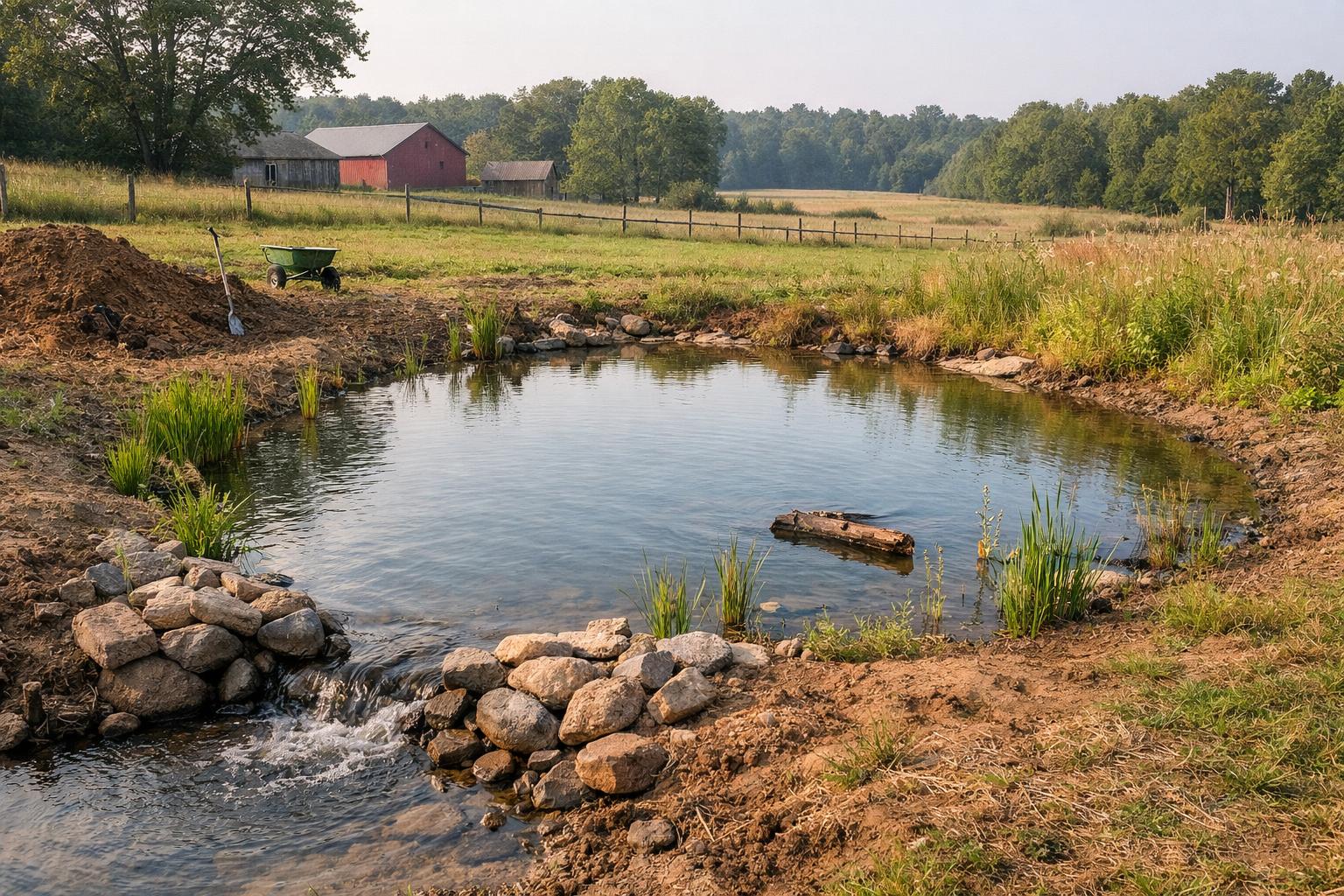
Why a Pond Changes Everything on Rural Land
Water is the single resource that concentrates wildlife more reliably than almost anything else. A pond — even a small one — creates a gravitational pull on deer, turkey, waterfowl, songbirds, amphibians, and countless other species. It also adds real value to rural property, provides a water source for livestock, and creates a firebreak in dry conditions — a benefit that connects naturally to a larger firebreak network across your property.
The challenge is that most small farm ponds fail within ten years — they leak, silt up, or overflow incorrectly and wash out the dam. This guide focuses on building it right the first time: picking the best site, sizing the pond to your watershed, designing a spillway that won't fail, and managing the pond once it's full so it stays productive for wildlife and practical for the property.
Choosing the Right Site
Site selection is the most important decision in the entire project. A bad site wastes money and delivers a pond that never holds water reliably. A good site almost builds itself.
Look for a natural low point with an upper watershed. The best pond sites have a natural bowl or draw where runoff already collects after rain. Walk your property after a significant rain event and note where water runs and pools. A seasonal wet area that holds water for weeks after a storm is often an ideal pond site — the soil already has low permeability, and there's a natural drainage catchment feeding it.
Calculate your watershed area. Your pond needs enough watershed — the uphill acreage that drains into the pond site — to fill and maintain it through dry periods. A rough rule of thumb: plan for at least 5 to 10 acres of watershed per acre-foot of pond volume. In drier climates, push that ratio higher. In wet climates, you may have plenty of runoff from just a few acres. Your local USDA Natural Resources Conservation Service (NRCS) office can pull watershed maps for your property for free.
Check the soil. Clay-heavy soil holds water. Sandy or gravelly soil loses it. Dig a test hole 3 to 4 feet deep at the proposed pond bottom. If you see heavy clay — soil that holds its shape when squeezed and wet — you likely have a viable site. If the soil is sandy or full of gravel, you'll need a compacted clay liner or a synthetic liner to hold water, which significantly increases cost.
Avoid sites with large trees on the dam footprint. Tree roots decay over decades and create water pathways through a dam that eventually cause blowouts. Clear the dam area completely before construction and keep it free of woody vegetation permanently.
Sizing and Depth
For a wildlife pond on rural property, target a surface area of half an acre to 2 acres. Smaller ponds overheat in summer, grow aquatic vegetation wall-to-wall, and produce poor fish and amphibian habitat. Larger ponds cost significantly more to excavate.
Depth matters more than surface area for water quality. Shallow ponds — less than 4 feet — heat up, grow dense aquatic weeds, and stratify poorly. Design the deepest portion of the pond to be at least 8 to 10 feet deep. This deep zone stays cool in summer, provides oxygen refuge for fish during hot weather, and resists complete freezing in moderate winters. Slope the banks at a 3:1 or 4:1 ratio (3 to 4 feet of horizontal run for every 1 foot of depth) for bank stability and to make the pond easier to mow and manage around the edge.
Dam Construction
If your pond is in a draw or valley rather than a simple excavated bowl, you'll need a dam to hold the water. The dam is the most critical structure — failure here means losing the entire pond in a single event.
Use only clean clay fill. The dam must be built entirely of compacted clay, free of organic material, roots, and large rocks. Organic material decomposes and creates voids. Rocks create preferential flow paths. Dozer operators experienced with pond construction know how to stage and compact fill correctly — this is not a job to cut corners on.
Build wider and taller than you think you need. The top of the dam should be at least 8 feet wide to allow equipment access for maintenance. Dam height should provide at least 2 feet of freeboard above the emergency spillway level. Settlement after construction typically compresses a dam by 10 to 15 percent, so build the dam higher than final grade to compensate.
Install a drain pipe during construction. A 6-inch to 8-inch PVC or corrugated metal drain pipe through the base of the dam — called a monk drain or drawdown pipe — allows you to lower or drain the pond for maintenance, emergency repairs, or fish management. Installing it during dam construction costs very little; installing it later requires draining and partially removing the dam.
Spillway Design — Where Most Ponds Fail
An undersized or poorly placed spillway is the most common cause of pond dam failure. When overflow overtops the dam rather than routing through the spillway, erosion starts and can blow out the dam in a single storm event.
Use a principal spillway and an emergency spillway. The principal spillway handles routine overflow — it's typically a pipe through or over the dam set at normal pool level. The emergency spillway is a wide, vegetated earthen channel cut at least 1 foot below the top of the dam that handles extreme inflow events. Both are necessary.
Size the emergency spillway to your watershed. For small ponds with 10 to 30 acres of watershed, an emergency spillway cut 4 to 6 feet wide and 1 to 2 feet deep is usually adequate. Larger watersheds require wider and deeper spillways. Your local NRCS office can calculate the correct dimensions using 25-year or 50-year storm event data — use this service before building.
Protect the spillway with vegetation immediately. Bare soil in a spillway erodes fast. Seed it with a fast-establishing grass mix the same week the dam is completed. Until grass establishes, place erosion control matting in the channel to prevent rilling.
Establishing Beneficial Vegetation
A newly filled pond is a blank slate. What you plant — or allow to establish — around the margin determines how useful it becomes for wildlife.
Leave a strip of native wetland vegetation on 40 to 60 percent of the shoreline. Cattails, bulrushes, sedges, and native emergent plants provide nesting cover for ducks and herons, insect habitat for fish, and thermal cover for deer and other mammals drinking at the pond. Don't mow or spray the entire shoreline — a manicured pond edge looks clean but provides almost no wildlife value.
Plant shallow-water native vegetation intentionally. Buttonbush, lizard's tail, and native sedges can be planted directly into the margins in 6 to 18 inches of water. These species establish quickly and provide structure that fish fry and waterfowl need.
Seed the dam and surrounding bare soil with a native grass and wildflower mix. Native grasses hold the dam surface, reduce erosion, and create additional upland cover adjacent to the water. Avoid mowing the dam during the first two growing seasons to allow root systems to establish.
Long-Term Pond Management
A pond requires ongoing attention to stay productive and structurally sound.
- Inspect the dam and spillway after every significant rain event. Look for seepage on the downstream face, settlement cracks on the dam crest, and erosion in the spillway. Small problems caught early are cheap to fix; ignored problems become dam failures.
- Manage aquatic vegetation annually. Some aquatic vegetation is beneficial; complete coverage kills the pond. If more than 30 percent of the surface is covered by floating or emergent plants, consider a partial treatment with approved aquatic herbicide or mechanical removal.
- Stock fish to control insects and add value. Largemouth bass and bluegill are the standard combination for most farm ponds. Bluegill reproduce and provide forage for bass; bass control the bluegill population and provide fishing opportunities. Stock at a ratio of 10 bluegill to 1 bass, introduced simultaneously. Your state fish and wildlife agency may offer subsidized pond stocking programs.
- Keep livestock off the banks. Cattle and hogs destroy bank vegetation, compact and erode pond edges, and contribute nutrients that fuel algae blooms. Fence the pond with a single strand of electric wire at the waterline and allow access only at a designated watering point reinforced with concrete or geotextile fabric. If a creek or drainage channel feeds the pond, building a proper water gap where the creek crosses your fence prevents livestock from bypassing the controlled access point.
Cost Expectations and Assistance Programs
A professionally built half-acre to 1-acre pond with proper spillways typically costs $8,000 to $20,000 depending on site conditions, soil type, and regional equipment rates. Sites with deep clay soils, gentle topography, and a natural low point are on the low end. Sites requiring long hauls, rock removal, or liner installation push toward the high end.
USDA's Environmental Quality Incentives Program (EQIP) provides cost-share funding for farm ponds that serve conservation purposes — livestock water, wildlife habitat, or irrigation. Applications are competitive but can cover 50 to 75 percent of construction costs in many states. Contact your local NRCS office in late summer or fall, when the next year's application cycle typically opens, to discuss whether your project qualifies.
A pond built with attention to site selection, proper spillway sizing, and correct dam construction will outlast the landowner who built it. It becomes a permanent feature that improves the property ecologically, financially, and aesthetically — and concentrates wildlife in ways that make every other habitat improvement on the property more effective. Understanding how deer select bedding areas near water helps you position the pond for maximum year-round use.
Stop Seeing Deer Only at 2 AM — Get the Free 10-Point Habitat Fix
Your property has specific, fixable gaps — and most 1–50 acre hunters never find them. This free checklist pinpoints exactly what's missing and tells you what to change first so deer start showing up when you can actually hunt them.
- ✓ The food plot timing that pulls deer into daylight hours
- ✓ How to build bedding cover with just a chainsaw (no equipment needed)
- ✓ Stand placement mistakes silently blowing out your property
- ✓ The #1 pressure rule most hunters skip — and deer remember
- ✓ Low-pressure access routes most small acreage owners never plan