How to Establish Native Warm-Season Grasses for Wildlife Cover
Why Native Warm-Season Grasses Belong on Your Property
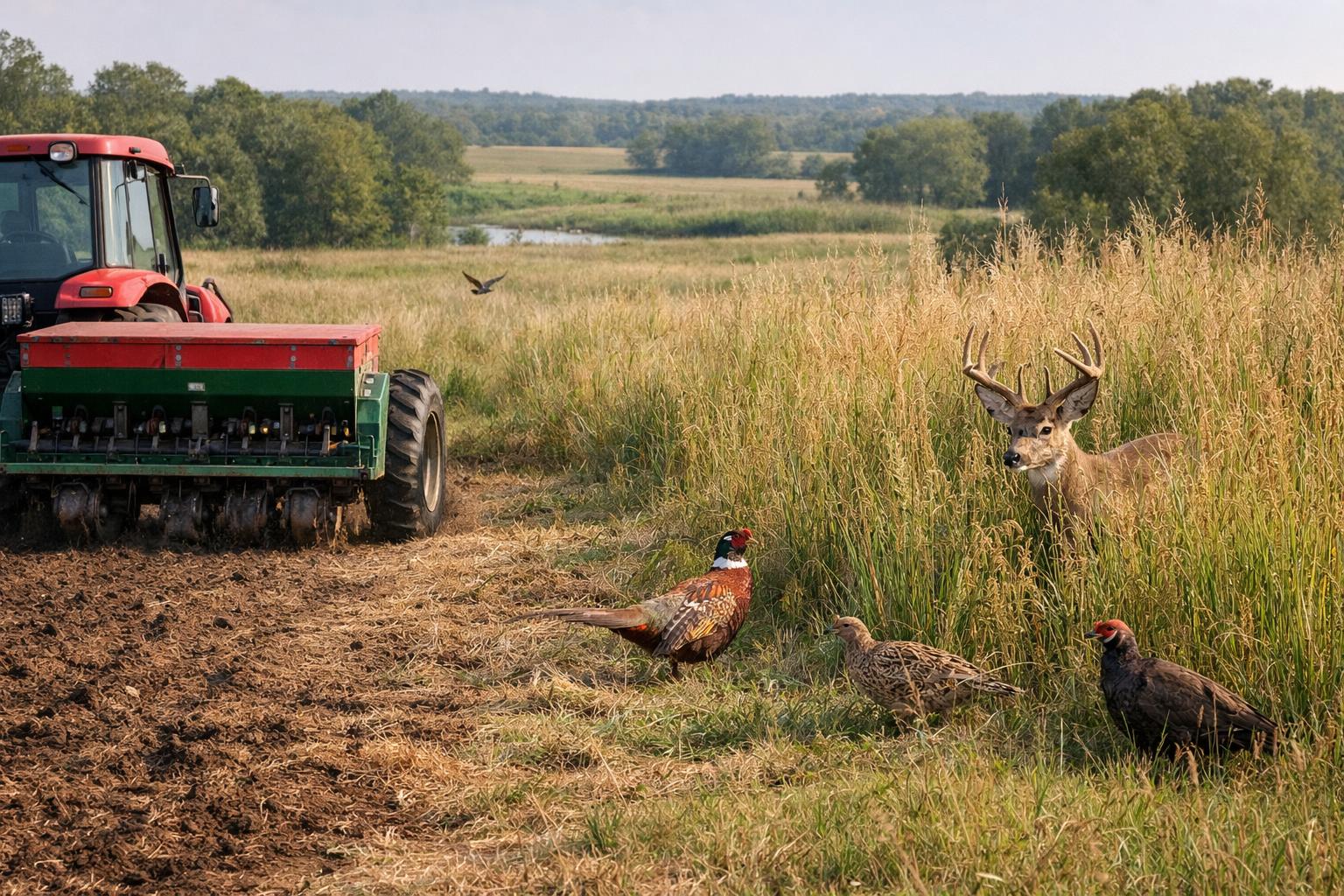
Walk through a stand of mature switchgrass in November and you'll understand immediately why wildlife gravitates to it. The stems are dense, the canopy overhead blocks wind and weather, and the seed heads that persist through winter feed everything from sparrows to turkey. Native warm-season grasses (NWSGs) are one of the highest-value habitat improvements a rural landowner can make — and unlike food plots, a well-established stand requires almost no annual inputs after the first two years.
The four grasses most commonly established for wildlife in the eastern and central United States are switchgrass, big bluestem, indiangrass, and little bluestem. Each has its own growth habit and peak value for different species. Switchgrass grows the tallest and densest, making it the top choice for deer bedding and pheasant nesting. Big bluestem and indiangrass are slightly shorter and mix well with wildflowers for quail and songbird habitat. Little bluestem is shorter still, thrives on dry, poor soils, and provides excellent thermal cover through fall and winter.
The fundamental appeal of NWSGs is their deep root systems — switchgrass roots can reach 10 feet down — which means they are drought-tolerant once established, hold soil on slopes, and improve the land with minimal ongoing management.
Choosing Your Site
NWSG establishment success starts with site selection. These grasses thrive on sites where the soil has been historically disturbed or is low in fertility — which is counterintuitive compared to how most people think about planting.
Avoid high-fertility soils if you can. Rich, productive crop ground will favor cool-season grasses and weeds over your NWSG seedlings. NWSGs evolved on low-to-moderate fertility sites and are naturally competitive there. If you're converting a fallow field or brushy edge, you're probably on the right track. Highly productive crop ground needs more aggressive site prep to give NWSGs a fair start.
Prioritize edges and transition zones. The most wildlife-productive NWSG stands are adjacent to food sources — food plots, crop fields, hardwood flats with mast production. Deer and turkey will use dense grass cover much more heavily when quality food is within a few hundred yards. A 2- to 5-acre block positioned between a bedding area and a food source is worth far more than a stand isolated in the middle of a field. For a detailed look at how deer choose and use bedding sites — so you can position your grass planting for maximum impact — see Understanding Deer Bedding Areas on Small Acreage.
Check drainage. Switchgrass tolerates wet soils and will outcompete most grasses on moist, lowland sites. Big bluestem and indiangrass prefer well-drained upland conditions. Little bluestem handles dry, rocky, or sandy soils where other NWSGs struggle. Match the species mix to what you have.
Site Preparation: The Step You Can't Skip
Poor site prep is the leading cause of NWSG establishment failure. Competing vegetation — fescue, bromegrass, and annual weeds — will smother your seedlings before they can establish a root system. Eliminating existing vegetation before you seed is non-negotiable.
Option 1: Herbicide burndown (most effective). In the fall before your spring planting, apply a non-selective herbicide like glyphosate to the existing vegetation after it greens up in early fall. This kills the existing stand. The following spring, wait for a flush of weed seedlings to emerge, then apply glyphosate again 2–3 weeks before seeding. Two applications kill the existing stand and the weed seedbank that germinated after the first application.
Option 2: Tillage. If you prefer a no-herbicide approach, disk the site aggressively in fall to destroy existing vegetation, then till shallowly in spring just before seeding to set a firm seedbed without bringing buried weed seeds to the surface. This works but requires multiple passes and still leaves you vulnerable to weed pressure.
Do not skip soil testing. NWSGs don't need high-fertility soil, but a pH below 5.8 will significantly reduce germination and establishment. If your soil pH is low, apply lime the fall before seeding — lime takes months to work into the soil. Don't apply high-nitrogen fertilizer the establishment year; it will fuel your weeds, not your grass seedlings.
Seeding Timing and Method
The ideal seeding window for NWSGs is late spring to early summer, when soil temperatures are consistently above 65°F at a 2-inch depth. In most of the South and Midwest, that's late April through June. Dormant seeding — applying seed in late fall or winter before the ground freezes — is the second-best option and works well in northern states where the spring window is short.
Seeding rates depend on the species mix. A common all-purpose wildlife mix is:
- Switchgrass: 4–6 pure live seed (PLS) pounds per acre
- Big bluestem: 3–4 PLS lbs/acre
- Indiangrass: 2–3 PLS lbs/acre
- Native wildflower mix (optional): 1–2 lbs/acre
Broadcast seeding works but requires a firm, packed seedbed so seed makes good soil contact. A cultipacker or roller run before and after seeding improves germination dramatically. Drill seeding with a native grass drill set to shallow depth (¼ inch or less) is the most reliable method when equipment is available — many NRCP district offices and state wildlife agencies loan or rent native grass drills to landowners.
Do not bury the seed deep. NWSG seeds are tiny and the seedling has very little energy reserve. Seeding deeper than ¼ inch leads to poor germination. On a prepared seedbed, broadcasting and then rolling is often sufficient.
First-Year Management: What Most People Get Wrong
The most common mistake new NWSG planters make in the first season is looking at the field in July and thinking the planting failed. Native warm-season grasses establish their root system in year one, not their top growth. A successful planting may look like nothing more than scattered short seedlings surrounded by weeds — but underground, the roots are building the infrastructure that will support 20+ years of growth.
Mow, don't spray, the first summer. When weeds get 18–24 inches tall, mow them down to 8–10 inches. This removes the weed canopy that would shade out your seedlings without harming the grass seedlings, which are shorter and below the mower blade. Do not apply herbicides in the establishment year unless you are confident in species identification — broadleaf herbicides will kill your wildflowers, and some grass-specific herbicides can damage NWSGs.
One mowing at the right time is usually sufficient. Mow once in early-to-mid summer if weed pressure is high, then leave the stand alone through fall. Going into winter with standing cover, even if it's weedy, protects your seedlings from frost heave.
By the end of year two, an established stand will be competitive enough to suppress most weeds on its own.
Long-Term Maintenance: Keeping Stands Productive
Once established, NWSGs require almost nothing — but occasional management prevents the stand from declining.
Burn every 3–5 years. Prescribed fire in late winter or early spring removes accumulated dead thatch, stimulates new growth from the root mass, and sets back any woody encroachment. If four- to ten-inch hardwoods are encroaching the stand edge, consider hinge cutting them rather than killing them outright — the fallen tops create a layered bedding fringe that deer use alongside the open grass interior. A healthy stand of switchgrass will respond to fire with vigorous new growth the same season. If burning is not an option on your property, a light disk or mowing in early spring achieves a similar reset.
Rotate burning or mowing sections. Don't burn or mow the entire stand in a single year. Leave at least half the stand undisturbed each year so that nesting birds and overwintering animals always have some standing cover available. A simple two- or three-section rotation keeps the stand productive while maintaining continuous wildlife value.
Manage for structure, not just grass. The best NWSG stands have some structural diversity — slightly open areas where shrubs or wildflowers are interspersed with dense grass blocks. Leaving unmowed or unburned patches for a year or two creates this structure naturally.
What to Expect and When
Year 1: Thin, scattered seedlings. Lots of weeds. Normal and expected.
Year 2: Grass stands thicken noticeably. You'll start seeing deer trails through the stand.
Year 3: A well-established planting hits full height and density. Deer, turkey, pheasant, and songbirds are using it consistently.
Year 5+: The stand is a self-sustaining habitat feature that requires only periodic fire or mowing to maintain.
The initial establishment effort — site prep, seeding, and first-year mowing — is the entire investment. After that, the land pays you back in wildlife every season. Maintaining a mowed firebreak along the edges of your grass stand creates a natural containment line for prescribed burns and improves equipment access — How to Establish a Firebreak on Rural Property covers the planning and maintenance approach.
Stop Seeing Deer Only at 2 AM — Get the Free 10-Point Habitat Fix
Your property has specific, fixable gaps — and most 1–50 acre hunters never find them. This free checklist pinpoints exactly what's missing and tells you what to change first so deer start showing up when you can actually hunt them.
- ✓ The food plot timing that pulls deer into daylight hours
- ✓ How to build bedding cover with just a chainsaw (no equipment needed)
- ✓ Stand placement mistakes silently blowing out your property
- ✓ The #1 pressure rule most hunters skip — and deer remember
- ✓ Low-pressure access routes most small acreage owners never plan